DEBT PROFILE UNDER YAR’ADUA ADMINISTRATION.
A total of 6.17 trillion naira was incurred as debt under the Yar’adua administration, making it the second highest after president Obasanjo.
DEBT PROFILE UNDER JONATHAN’S ADMINISTRATION
At the beginning of former President Goodluck Jonathan’s tenure in 2011, the federal government had an accumulated debt of N6.17 trillion.
Analysis of the debt figure showed that local debt amounted to N5.62 trillion while foreign debt stood at $3.5 billion (about N548.65 billion, using the exchange rate of N156.7/$1).
By the end of 2015, the foreign debt component hit $7.3 billion, while domestic debt increased by N8.4 trillion.
HOW MUCH BUHARI BORROWED IN 6 YEARS
The Budget Office’s medium-term expenditure framework and fiscal strategy paper from 2015 showed that the Buhari-led administration incurred N7.63 trillion in domestic debt from June 2015 to December 2020.
On external borrowings, President Buhari increased debt from $7.3 billion in 2015 to $28.57 billion as of December 2020. This means that the president incurred $21.27 billion on foreign loans to the country’s debt portfolio.
The country’s exchange rate moved from N197 to a dollar in 2015 to N381 at the end of December 2020.
Analysis of consolidated debt showed that the external debt increased by 291.37 percent while domestic debt grew by 86.31 percent in the last six years of the Buhari government.
Overall, the Buhari-led government has had an accumulated debt of N17.06 trillion as of March 2021, using the N381 exchange rate. This represents a 173.2 percent increase from when he was elected president in 2015.
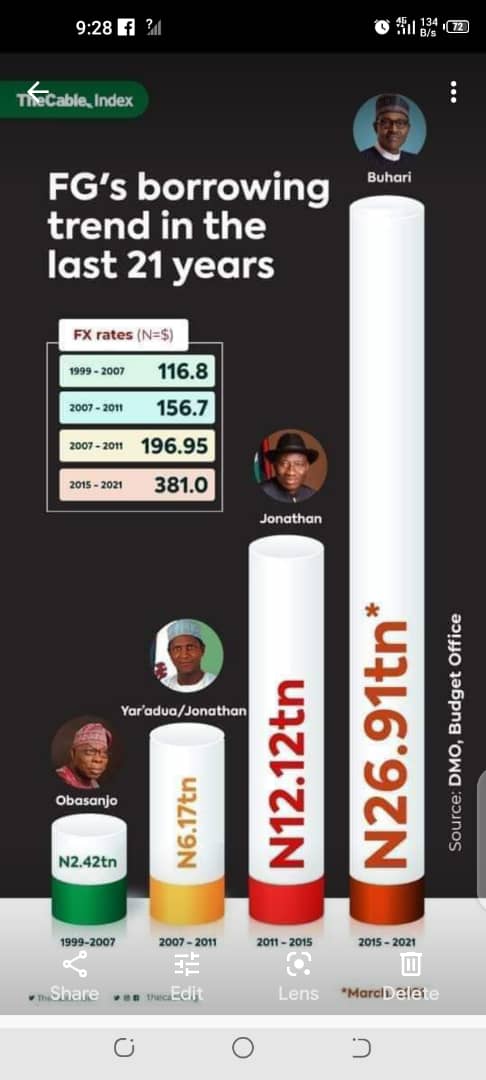
Nigeria’s public debt has been on the rise. Despite securing debt relief during the Olusegun Obasanjo-led administration, successive governments have continued on a borrowing spree.This has raised concerns among Nigerians on the debt sustainability of the country amid dwindling revenue to meet the debt obligations to creditors.
On July 7, 2021, the upper chamber approved a loan request of N2.343 trillion, approximately $6 billion and another $8.3 billion and €490 million.
“The proposed new capital raising is the new external borrowing provided in the 2021 Appropriation Act to part finance the deficit in the budget. In other words, the new capital raising has already been approved in the budgetary process by the executive and legislative arms of government,” the DMO had said in a statement.
As of March 2021, Nigeria’s total public debt has hit N33.1 trillion ($87.24 billion) — an accumulation of borrowings from successive governments, of which most were borrowed since the return to democratic rule in 1999.
The overall public debt is the total debt accrued by federal, states, and the FCT from local and international lenders.
Of the N33.1 trillion, the federal government alone borrowed N26.91 trillion — this includes the FGN bonds, Sukuk, green bonds and Euro bonds.
Finally, after weeks of data aggregation, number crunching, dissecting and analyses of freedom of information (FOI) response from the Debt Management Office (DMO), TheCable presents findings that highlight how Nigeria’s aggressive borrowing defies its fiscal responsibility laws.
FG DEBT CLIMBED 658% TO N26.9 TRILLION IN 21 YEARS
Data from the DMO seen by TheCable showed that federal government borrowings (local and foreign debt) climbed from N3.55 trillion in 1999 to N26.91 trillion at the end of March 2021 (the country’s latest official figure).
This represents a 65.8 percent increase in 21 years, comprising the administrations of Olusegun Obasanjo, Umar Musa Yar’Adua, Goodluck Jonathan, and the current Muhammadu Buhari.
DEBT PROFILE UNDER OBASANJO ADMINISTRATION.
Under the Obasanjo regime, it was recorded that a total of 2.42 trillion naira was incurred from the period of 1999 to 2007.

 Site Title